
Signs Your Water Heater Needs Replacement: 2026 Costs
Short answer
The primary signs your water heater needs replacement include unit age exceeding 10 years, rust-tinted hot water signaling inner tank corrosion, audible rumbling or popping during recovery caused by sediment buildup, and requiring repairs more than twice a year. ENERGY STAR recommends replacing any storage water heater older than 10 years, as typical storage tanks last about 13 years and suffer performance declines before failing.
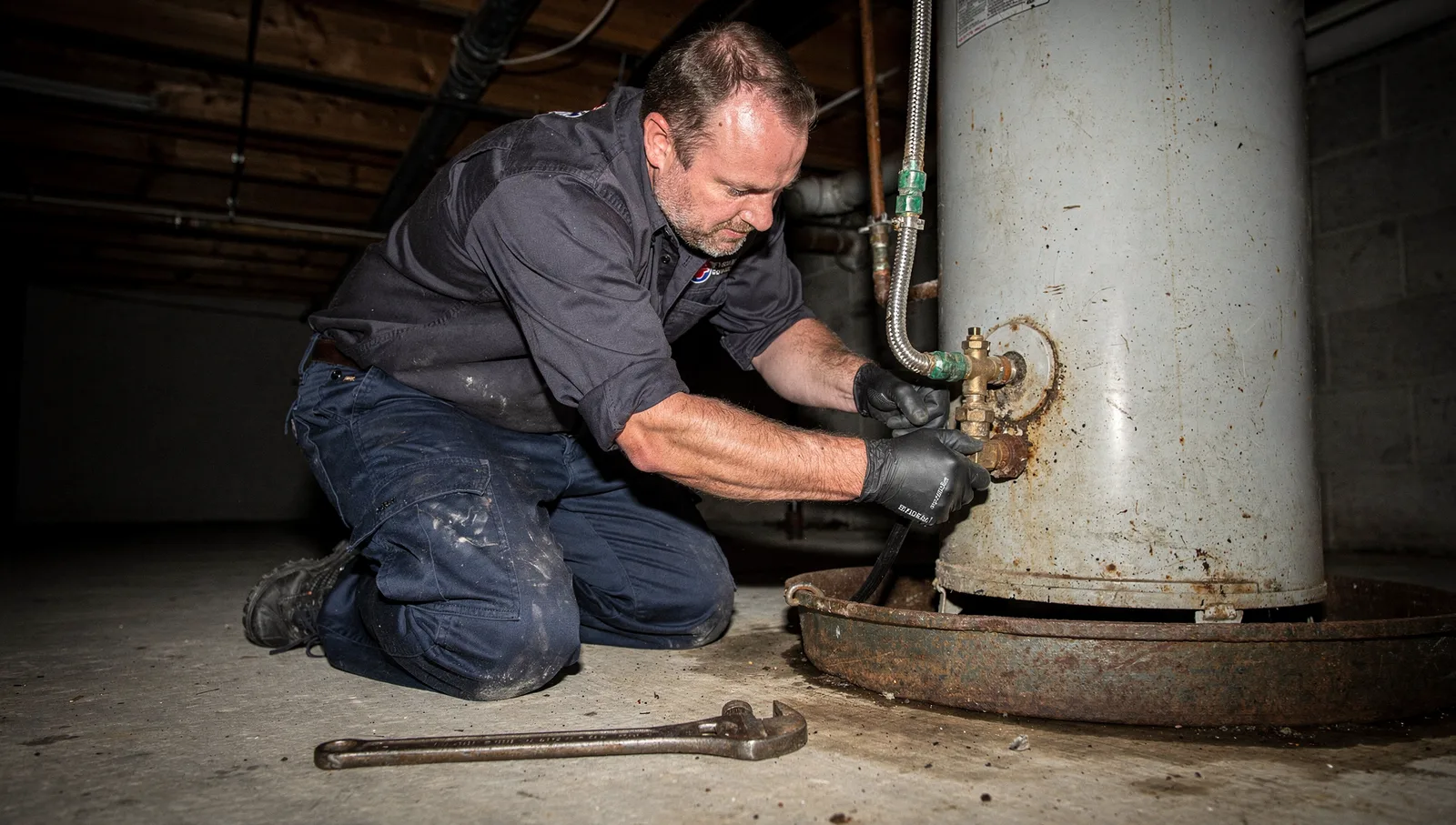
“The average storage water heater lasts about 13 years, but once yours starts to leak, it’s already too late to compare prices and benefits.”
ENERGY STAR, Government Program Guide, U.S. Department of Energy / ENERGY STAR
Water heater replacement is fundamentally a scheduled risk-mitigation deadline rather than an open-ended maintenance dilemma. Waiting for total physical failure strips away homeowner negotiating leverage, forcing emergency call-out surcharges instead of cost-controlled installation (waterheaterinstallationcost.com).
- Symptom detection
- Repair threshold evaluation
- Planned installation
Operational Performance, Unit Age, and Repair versus Replacement Considerations#
Audible tank distress, advanced age, and recurring service calls are definitive signs that a water heating system requires total replacement rather than ongoing component repairs (energystar.gov; waterheaterinstallationcost.com; wgsmartsavings.com). ENERGY STAR advises homeowners to replace a storage water heater if the equipment is more than 10 years old, and notes that the average storage water heater lasts about 13 years.
Performance degradation typically accelerates after a tank passes its tenth year of service (waterheaterinstallationcost.com; wgsmartsavings.com). A critical indicator of imminent failure is rust-tinted hot water, which demonstrates that the sacrificial anode rod has expired and the internal tank lining is actively corroding. The anode rod is a sacrificial metal core designed to attract corrosive elements away from the steel tank walls. In addition, audible rumbling or popping sounds during heating cycles indicate heavy sediment buildup, which creates hot spots and mechanical stress along the tank bottom.
Evaluating cumulative repair expenses against replacement cost prevents pouring capital into an expiring appliance. Evaluating unit longevity alongside active physical symptoms clarifies when repair ceases to be economically sound:
| Evaluation Metric | Repair Threshold | Replacement Trigger | Primary Failure Mechanism |
|---|---|---|---|
| Unit Age | Under 10 years (energystar.gov) | Over 10 years | Tank wall thinning and insulation breakdown (waterheaterinstallationcost.com) |
| Operational Noise | Occasional hum | Rumbling or popping during recovery (waterheaterinstallationcost.com) | Sediment buildup stressing the tank floor |
| Water Clarity | Clear domestic hot water | Rust-tinted hot water (waterheaterinstallationcost.com) | Corrosion of the internal steel tank lining |
| Repair Frequency | Isolated component fix | More than two service calls annually (wgsmartsavings.com) | Systemic component fatigue and wear |
Once an aging appliance demonstrates multiple physical symptoms like sediment popping or discolored supply lines, bringing in professional replacement assistance becomes the most cost-effective path forward.
Active Tank Leaks vs Valve Leaks#
Not every puddle means a dead tank. Water dripping from the temperature and pressure relief valve outlet or seeping around the drain valve stem points to a replaceable fitting, and a plumber can usually swap either part on a younger unit. Water weeping from the tank seam, the bottom of the jacket, or through the insulation means the steel tank itself has corroded through, and no repair exists for that: plan replacement immediately.
Lukewarm or Insufficient Hot Water#
Running out of hot water faster than you used to has two common causes. On gas units, sediment piled on the tank floor takes up volume and insulates the water from the burner. On electric units, a failed lower heating element leaves only the top of the tank heating. A failed element or thermostat on a young unit is a repair; the same symptom on a tank past 10 years, especially alongside rumbling, is a replacement signal.
Repair vs Replace Cost Threshold#
A simple rule: if the unit is past 10 years old, or this would be the third service call within a year, put the repair quote toward a new heater instead (wgsmartsavings.com). Compare the repair price against the $1,200 to $2,300 cost of a scheduled replacement; spending a meaningful share of that on an aging tank only delays a bill you will still pay, often at emergency rates.
Energy Efficiency Loss and Rising Utility Bills#
Sediment and scale make the burner or elements run longer to heat the same water, so an aging tank tends to show up first as a creeping gas or electric bill with no change in household use. Replacing on schedule also lets you pick a higher-efficiency model rather than whatever unit is on the truck during an emergency call.
Plumbing Code and Installation Requirements Applicable to Water Heater Replacements#
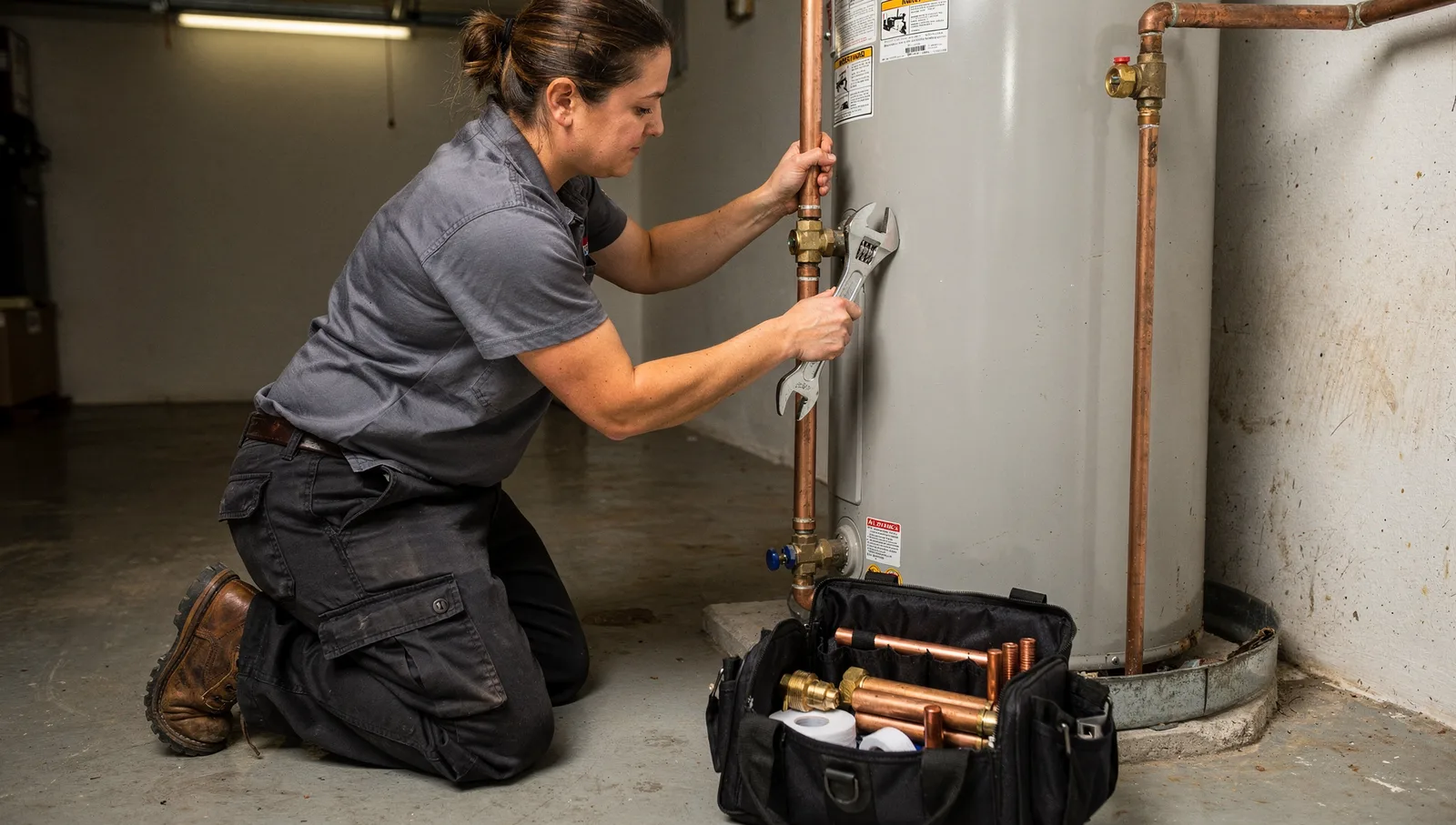
Replacement installations must meet International Plumbing Code (IPC) rules for relief valves, drain valves, shutoff valves, and service clearance. Under the International Plumbing Code (IPC), temperature and pressure relief valves (safety valves designed to discharge automatically if heat or internal tank pressure spikes) must bear the label of an approved agency (codes.iccsafe.org). These relief devices must maintain a temperature setting of not more than 210°F (99°C) and a pressure setting not exceeding the equipment's rated working pressure or 150 psi (1035 kPa), whichever is lower. The IPC requires relief valve discharge piping to terminate through an air gap located in the same room as the water heater. An air gap is an unobstructed vertical physical separation between a discharge pipe and an indirect waste receptor that prevents backflow contamination.
Drain valves installed at the base of storage water heaters must feature an inlet of not less than 3/4-inch nominal iron pipe size, paired with an outlet providing male garden hose threads (codes.iccsafe.org). However, the IPC clarifies that a pan drain is not mandatory on a replacement installation if one was not previously piped in the dwelling.
- Dedicated cold water valves must be installed on the branch line near the water heater to isolate the appliance without interrupting cold water delivery to the remainder of the structure (codes.iccsafe.org).
- Control compartments require a level clear working space measuring at least 30 inches by 30 inches (762 mm by 762 mm) directly in front of the service panel.
- When earthquake loads apply under the International Building Code, water heater mounting assemblies must be engineered to resist seismic forces.
- Field execution cannot be treated as an unmonitored home project. According to the Colorado State Plumbing Board (2015), the installation and replacement of domestic water heaters must be performed by a licensed plumber employed by a registered plumbing contractor, requiring a formal municipal permit and post-installation inspection (cilovelandco.civicweb.net).
Comparing Planned Water Heater Replacement and Emergency Failure Replacement#
The financial spread between a proactive replacement and an emergency call-out underscores the commercial value of tracking equipment age. Waterheaterinstallationcost.com reports that emergency same-day water heater replacement across all unit types ranges from $1,100 to $4,000 (waterheaterinstallationcost.com), representing a 20 to 50 percent pricing premium over planned installations due to after-hours surcharges and dispatch urgency. In contrast, a scheduled installation of a standard 50-gallon gas unit prior to failure at year 11 or 12 costs between $1,200 and $2,300. For that same 50-gallon gas unit failing on a Saturday night, the install can run $2,000 to $4,800, excluding secondary property restoration expenses from uncontrolled water intrusion.
Scheduled baseline: $1,200 to $2,300
Emergency failure baseline: $2,000 to $4,800 + restoration expenses
Avoided operational penalty: $800 to $2,500 direct installation spread
Strategic scheduling preserves contracting leverage. Waterheaterinstallationcost.com notes that emergency dispatches are typically assigned to whichever contractor can arrive fastest rather than the most vetted or cost-competitive firm (waterheaterinstallationcost.com). Planned appointments provide the necessary time window to gather two or three competitive quotes, review verified consumer ratings, and check municipal trade licenses.
If a catastrophic tank rupture has not occurred, property owners can deploy intermediate operational scheduling tactics to limit installation premiums:
- Non-Leaking Electrical or Element Failure: Shutting off the supply line and electrical breaker to schedule a standard appointment rather than an unscheduled emergency call saves between $400 and $1,000 in immediate labor surcharges (waterheaterinstallationcost.com).
- Scheduled Next-Business-Day Conversion: When a leaking tank is fully drained and contained, booking next-business-day installation incurs standard commercial rates alongside a priority premium of $50 to $150, avoiding the full emergency surcharge.
- Early-Morning Slot Optimization: Converting an unrouted after-hours dispatch into a first-run morning slot on the next regular business day yields $200 to $700 in waived emergency contractor premiums.
To evaluate your immediate water heater situation, audit the serial number on your unit's data plate this week to identify its true manufacturing year. If the appliance exceeds 10 years of service or has needed more than two repairs this year, call two or three licensed plumbing contractors for written replacement quotes now and book the install on a weekday, before a leaking tank sets the price for you.
| System Component | IPC Minimum or Maximum Requirement | Operational Function |
|---|---|---|
| Temperature & Pressure Relief Valve | Max 210°F (99°C); max working pressure or 150 psi (whichever is less) | Prevents dangerous overheating and vessel overpressurization |
| Relief Valve Discharge Piping | Discharge through an air gap in the same room as the water heater | Eliminates cross-contamination and backflow to the drainage system |
| Tank Drain Valve | Inlet ≥ 3/4-inch nominal iron pipe size; male garden hose thread outlet | Enables clean tank flushing, sediment clearing, and draining |
| Safety Pan Dimensions | Depth not less than 1.5 inches (38 mm) | Catches tank leaks and condensation before water damage occurs |
| Safety Pan Drain Line | Indirect waste pipe diameter ≥ 3/4 inch (19 mm) | Safely channels overflow to a receptor, drain, or exterior ground |
| Exterior Pan Drain Termination | 6 inches to 24 inches above adjacent ground surface | Provides clear gravity discharge above exterior grade |
| Service Clearances | Level working space ≥ 30 inches by 30 inches at control side | Ensures compliant physical access for inspection and replacement |
| Cold Water Branch Line | Dedicated shutoff valve near equipment, serving only the water heater | Allows unit isolation without cutting water to the rest of the dwelling |
| Service Scenario | Typical Replacement Cost | Labor or Dispatch Differential | Homeowner Strategic Advantage |
|---|---|---|---|
| Emergency Weekend / Night Failure | $2,000 to $4,800 + restoration | Up to 100%+ premium over scheduled | None; plumber selected on truck inventory and immediate availability |
| Contained / Non-Leaking Failure Delay | Standard rates | Saves $400 to $1,000 vs. emergency dispatch | Avoids rushed pricing; allows standard next-day appointment |
| Next-Business-Day Conversion | Standard rates + $50 to $150 | Eliminates full emergency surcharge | Priority morning booking when tank is isolated and drained |
| Early-Morning Reschedule Slot | Standard rates | Saves $200 to $700 in waived emergency fee | Converts emergency dispatch into regular business day schedule |
Frequently Asked Questions
What is the average lifespan of a home water heater?
According to ENERGY STAR, the average storage water heater lasts about 13 years, and ENERGY STAR recommends replacing any storage unit that is more than 10 years old.
What are the specific warning signs that my water heater is about to fail?
Key indicators include rust-tinted hot water showing internal tank corrosion, audible rumbling or popping from sediment buildup, moisture around the base, and requiring repairs more than twice a year.
How do I know if a repair will cost more than replacing the unit?
Replace rather than repair if your storage unit exceeds 10 years of age or requires service more than twice annually, which signals systemic fatigue and imminent tank failure.
Why is early detection better than waiting for complete failure?
Planning replacement avoids emergency rates of $2,000 to $4,800, saves $400 to $1,000 compared to after-hours dispatches, prevents water damage, and allows you to compare quotes and select energy-efficient equipment.
Sources
- CHAPTER 5 WATER HEATERS - 2021 INTERNATIONAL PLUMBING CODE (IPC) - codes.iccsafe.org
- Five Signs That It May Be Time to Replace Your Water Heater | Washington Gas - wgsmartsavings.com
- Water heater installations require plumbing license, permit ... - cilovelandco.civicweb.net (2015-10-26)
- Emergency Water Heater Replacement Cost: $1,100 to $4,000 Same-Day (2026) | WaterHeaterInstallationCost.com - waterheaterinstallationcost.com